Showing posts with label Vibal Foundation. Show all posts

Tuesday, April 5, 2022

Vibal Foundation Launches Colección Iberoasia Imprint with Dolors Floch’s Martín de Rada

Martín de Rada

About Martín de Rada (1533–1578): Book Highlights

In this first volume of VFI’s Colección Iberoasia imprint, sinologist and professor Dolors Folch recreates the ideals, life, times, and works of Fray Martín de Rada, both a man of science and a man of the cloth, who arrived in the Philippines in 1565 with Miguel Lopez de Legazpi’s expedition that established a Spanish colony in the islands.

An expert in astronomy and mathematics, indispensable for the invading Spanish missionaries and conquistadors, he was not just a witness to the first two decades of colonial rule in the Philippines, he was also the first to describe China to Spanish readers.

Although Fray Martín’s only surviving portrait depicts him as the quintessential scientist, he was, for his more than twelve years in the Philippines, also an author, a critical observer of the plight of native Filipinos, a missionary, and, most importantly, an ambassador to China in 1575.

Martín de Rada (1533–1578): Scientist, Missionary, and Spanish Philippine Diplomat to China explores the milestones in the man’s life that made him one of the most important players in Spain–China relations. It chronicles his early years as an Augustinian missionary in New Spain (Mexico) who was commended for his administrative talent, as well as his mathematical and scientific mastery, leading to his selection as part of the royal expedition to the Philippines under the command of Miguel López de Legazpi.

De Rada’s stay in the Philippines, as recounted in the book, proved crucial to the evolution of his beliefs about the real situation of the native population at the hands of the Spaniards who, as he reported to the Mexican viceroy, abused and left them impoverished.

The book also gives an account of his evangelization of the natives as he carried this experience to accompany a delegation to Ming-era China, a country that left an indelible impression on the Augustinian. He shared his experience of the country in his renowned Relación, which succeeding scholars would use as a primary reference on China.

About the author

Dolors Folch, professor emerita of the Department of Humanities of Pompeu Fabra University in Barcelona, Spain, was dean of the Faculty of Humanities from 1992 to 1999 and director of the School of East Asian Studies.

Aside from supervising the groundbreaking research La China de España Elaboración de un corpus digitalizado de documentos españoles sobre China de 1555 a 1900, she also curated the landmark 2007 exhibit Els grans viatges de Zheng He at the Museu Marítim de Barcelona.

Folch is the author of Els grans viatges de Zheng He (Angle, 2008), La Construcción de China (Península, 2002), La Fundació de l'imperi xinès (Empúries, 1991), and Wang Wei, Vell País Natal (Empúries, 1986).

About Vibal Foundation

Founded in 2007, Vibal Foundation is Vibal Group’s philanthropic arm. Its vision is to engage Filipinos in intellectual discussion of Philippine history, culture, and the arts by providing beautiful and insightful print and digital materials.

Its institutional partners are the Ateneo Art Gallery, Biblioteca Historica, Galleria Duemila, Gallery Genesis, International Rice Research Institute, National Historical Commission of the Philippines, National Museum of the Philippines, Philippine Departments of Labor and Education, Premio Zóbel, San Agustín Museum, Universidad Complutense, Madrid, and the UP Jorge B Vargas Museum.

Colección Iberoasia is Vibal Foundation’s first global publishing imprint offering digital and printed titles available on Amazon.

Martín de Rada (1533–1578): Scientist, Missionary, and Spanish Philippine Diplomat to China will be available in major bookstores, Shopee, Lazada, and Vibal Shop in May. Please follow Vibal’s FB page for announcements: www.facebook.com/vibalgroup

Friday, November 5, 2021

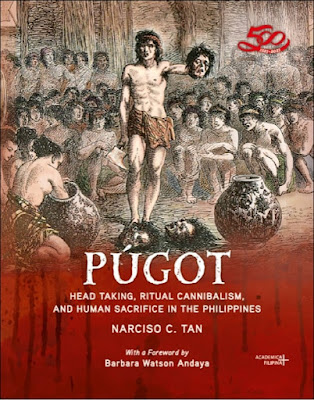
Vibal Foundation to Launch Púgot: Head Taking, Ritual Cannibalism, and Human Sacrifice in the Philippines

PUGOT

Vibal Foundation, Inc. (VFI) will be launching Narciso C. Tan's Púgot: Head Taking, Ritual Cannibalism, and Human Sacrifice in the Philippines at VFI’s monthly virtual tertulia this October. Encyclopedic and analytical in its approach, this scholarly book dissects the ritualized forms of violence such as human sacrifice, ritual cannibalism, and head taking in the prehistoric Philippines.

Púgot: Head Taking, Ritual Cannibalism, and Human Sacrifice in the Philippines
Púgot weaves together historical data and archaeological studies with traditional myths, legends, and songs to create a seamless narrative of some of the most misunderstood aspects of Philippine culture and to shed light on deeply rooted cultures of violence.

Preceding the emergence of Islam and Christianity, deeply held religious beliefs led various Philippine communities to sanction ritualized forms of violence: human sacrifice, cannibalism, and head taking. Today, many Filipinos see these practices as “primitive,” “barbaric,” or pertaining only to so-called “tribes” and therefore not related to the national dynamic. Púgot forces Filipino readers to contemplate and confront the not-so-ancient past, when their ancestors sported loincloths, battle gear, and talismans, and participated in violent community-wide celebrations and rituals.

The book also reveals these practices not in isolation, but as part of the wider Southeast Asian and Austronesian milieu. The multilingual primary and secondary texts used for this work are sourced from across centuries and disciplines, including thirteenth to eighteenth-century Chinese records, Spanish-period missionary chronicles, and European and American ethnographies from the late nineteenth to the early twentieth century, as well as folkloric accounts and epics.

VFI’s Academica Filipina

This book is the latest addition to VFI’s Academica Filipina+, which is an interdisciplinary series that pushes the boundaries of scholarly publishing with smart, literate, and thought-provoking works exploring the Philippine past, present, and future.

For interested readers, copies of Púgot: Head Taking, Ritual Cannibalism, and Human Sacrifice in the Philippines will be available for online purchase at the Vibal Online Shop at https://shop.vibalgroup.com/, Lazada https://www.lazada.com.ph/shop/vibal-books/, and Shopee https://shopee.ph/vibalgroup. For bulk orders or if you have queries, you may reach us through customercare@vibalgroup.com and marketing@vibalgroup.com or call us at +63 (2) 8580.7400 or 1-800-1000-VIBAL (84225).

Monday, July 19, 2021

Vibal Foundation’s Art Book Chronicles 123 years of Philippine Cinema

Vibal Foundation’s Art Book Chronicles
Vibal Foundation recently launched Philippine Cinema, 1897-2020—a lavishly illustrated art book that not only provides an in-depth retrospective of over a hundred years of Philippine cinema, but also simultaneously traces its history, genres, narratives, tropes, and lore while subjecting its rich filmography to critique and film theory. The book tracks Philippine cinematic beginnings as a technological marvel and its many turns up to the twenty-first century as it blindly accepted, appropriated, indigenized, and even attacked Western conventions through intentionally wicked but hilarious parodies.

Philippine Cinema, 1897-2020 is the latest addition to Arte Filipino, Vibal Foundation’s imprint on art books. Arte Filipino promotes Philippine artistic history and culture, and brings art into broader public view by pairing innovative scholarship with brilliantly reproduced visuals.

Written by Gaspar Vibal and Dennis Villegas and edited by film educator, curator, and archivist Teddy Co, Philippine Cinema, 1897-2020 boldly looks at the seamier side of the film industry with its unblinking examination of DVD plenitude and piracy, trafficking of low-brow exploitation flicks, dislocation of mainstream distribution brought on by the advent of streaming and Netflix, and the tragic loss of the cinematic archive and the consequent loss of national memory.

Philippine Cinema, 1897-2020

In Philippine Cinema, 1897-2020, a common thread runs through all its pages: a fevered cinephilia that equally valorizes the sublime and the ridiculous, from the socially realistic films set in the most miserable slums to the most inspired satires of spy capers and spaghetti westerns, and from the most profound critique to a weltering listmania of nostalgia and trivia. Its one hundred essays contain 1,200 notes and gossipy asides, plus over 1,315 images, which will equally delight any diehard movie buff or casual cinematic art lover.

The book is a retrospective survey of cinema from its birth in Spanish colonial Manila to the challenging era of the pandemic. Arranged chronologically in four periodizations, the book’s 100 essays on manifold aspects of cinema, such as its artistic language, conventions, narratives, textual sources, discourses on women, gender, modernity, and national identity as well as its inherent hybridity and undeniably transnational character are written primarily from an audience or fan perspective.

In seeking to elide the division that traditionally separated academic film discourse from the bakya (popular) or the commercial, the book posits a holistic approach to appreciating Philippine cinematic art. In acknowledging this populist bent, an attempt has been made nevertheless to balance this cinephile-driven art history with postmodern critique and film theory.

Philippine Cinema, 1897-2020 is part of the Arte Filipino series. The art books under the series aim to elevate Philippine artistic history and culture and bring art into broader public view. Other titles in the series include Fabian de la Rosa and His Times, The Life and Art of Botong Francisco, The Life and Art of David Medalla, The Life and Art of Francisco Coching, The Life and Art of Lee Aguinaldo, The Life and Times of Purita Kalaw-Ledesma, and The Life, Art, and Times of Damian Domingo; Fifty Shades of Philippine Art: Damián Domingo; Fifty Shades of Philippine Art: Francisco V. Coching; Fifty Shades of Philippine Art: Isabelo Tampinco; Fifty Shades of Philippine Art: Philippine Cinematic Art; Fifty Shades of Philippine Art: Toti Cerda; Fifty Shades of Philippine Art: Art of Window, Display, and Design; Fifty Shades of Philippine Art: Nono: The 19th-Century Masters of Angono; and Fifty Shades of Philippine Art: Lee Aguinaldo.

Interested readers may purchase Vibal books online at https://shop.vibalgroup.com/ and at Shopee https://shopee.ph/vibalgroup