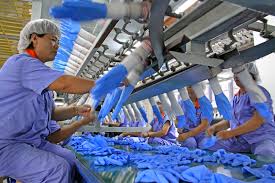
The Department of Trade and Industry-Regional Operations Group (DTI-ROG) and DTI-Region4A, through its Shared Service Facility (SSF) for Garments Production, collaborated with RelianceProducers Cooperative in Carmona, Cavite, in manufacturing laboratory gowns, jump suits, andface masks for the country’s healthcare workers.The initiative is in response to the call of the Department of Health (DOH) to work closely with theDTI, industry associations, and private firms to produce personal protective equipment (PPEs)locally.Established on April 4, 2017, the Reliance Producers Cooperative is a member of theConfederation of Wearables Exporters of the Philippines (CONWEP), which has been tapped bythe DOH to produce 10,000 PPE coveralls daily. The Cooperative is the first and only PhilippineEconomic Zone Authority (PEZA) registered and authorized to engage in garment manufacturingand exporting in the Philippines. It has 2,300 member-workers catering a wide range of productsto international customers with distinguished brands.Since April 8, 2020, Reliance Producers is manufacturing 600 lab gowns, 500 jump suits, and1,000 face masks per day with 300 member-workers. Upon the arrival of additional raw materials,they are targeting 5,000 pieces of PPE per day with added workforce.The DTI 4-A provided ten (10) units of single needle-lock stitch needle feed machine, six (6) unitsof over lock five-threads machine, six (6) units of cover stitch machine, four (4) units of buttonholemachine, and four (4) units of bar tack machine to the Cooperative on June 1, 2016. Presently,these machines are used to manufacture the PPEs, using raw materials that have metinternational standards for waterproofing and resistance to contaminants.“In this very difficult time, it is vital that we have enough PPEs for our healthcare workers to ensuretheir safety in this fight against COVID-19, and we are happy with the support that we are gettingfrom different sectors. The use of our SSFs to produce more PPEs is our way of helping andprotecting the healthcare workers and other frontliners since they are the ones who are mostexposed to dangers,” said DTI-CALABARZON Director Marilou Toledo.The SSF Project is a major component of the Micro, Small, and Medium Enterprise (MSME)Development programs to improve and develop competitiveness among the entrepreneurs bygiving them access to energy efficient technologies and more sophisticated equipment.Beneficiaries of the project are the actual and potential users of the SSF, which should bepredominantly cooperatives, associations, or groups of MSMEs including individual entrepreneurswho may not be members of cooperatives, associations, corporations, or organizations.
The Department of Trade and Industry (DTI) and the Department of Finance (DOF) push for greater support in the manufacture and importation of essential products during the Enhanced Community Quarantine (ECQ) by granting incentives through the Joint Memorandum Circular (JMC) No. 20-02, series of 2020 issued on 1 April 2020.
Under Republic Act No. 11469, otherwise known as “Bayanihan to Heal as One Act,” DTI and DOF are authorized to liberalize the grant of incentives for the manufacture and importation of critical equipment or supplies.
In order to achieve this, the two agencies shall ensure the availability of essential goods and require businesses to prioritize contracts, subject to fair and reasonable terms, for materials and services needed by the government in its campaign against the COVID-19 pandemic.
The importation of these goods shall be exempt from import duties, taxes, and other fees.
“We need to ensure that the disruptions in the supply chain are minimized, as well as give enterprises a reprieve from commonly imposed taxes,” said Trade Secretary Ramon Lopez.
“We will help our manufacturers, especially those partnering with medical institutions and hospitals, procure or produce these essential goods at reduced costs by providing them with tax breaks during this global health crisis,” said Finance Secretary Carlos Dominguez III.
Sec. Dominguez added, “This is the least the Duterte administration could do to help our healthcare front-liners win the battle against COVID-19 by ensuring their access to personal protective equipment (PPEs) and other necessities to protect themselves and to medicines and medical supplies to treat their patients."
The Trade Secretary also mentioned that this was the government's way of showing gratitude for the cooperation of enterprises despite the restricted movement and conditions imposed during the quarantine period.
The JMC covers the production and manufacture of medicines identified critical by the Department of Health (DOH), medical equipment and devices, personal protective equipment, surgical equipment and supplies, as well as laboratory equipment and its reagents.
It also applies to the support and maintenance for the following: bit.ly/DTIDOFJMC2002
The JMC likewise covers raw materials and packaging materials exclusively used for the production of the above-mentioned products.
Among the provisions of the RA 11469 is for the government to collaborate with the private sector and other stakeholders to deliver these measures and programs quickly and efficiently.
Sec. Dominguez assured that the Bureau of Customs (BOC) will be able to assist in the timely release of the imports of raw materials, packaging, and articles required in the supply chain of production.
“We urge our partners in the private sector for their continued understanding on the importance of the unimpeded production and importation of these essential products," said Sec. Lopez.
Meanwhile, Sec. Dominguez said, "We thank these manufacturers, institutions, and hospitals that continue to innovate and produce essential goods to help save Filipino lives in the face of the pandemic."
With the continued cooperation of the private sector and other involved agencies, DTI and DOF remain optimistic in minimizing the spread of the virus and its long-term impact on the local economy.
The JMC shall remain in effect only during the effectivity of RA 11469.
MANILA – The Department of Trade and Industry (DTI) released Memorandum Circular (MC) No. 20-12, Series of 2020 on 4 April 2020 granting a 30-day grace period for residential rent as well as a similar grace period for Micro, Small, and Medium Enterprises (MSMEs) with their commercial rent during the Enhanced Community Quarantine (ECQ) period in Luzon.
“To provide economic relief to Filipinos and MSMEs during the COVID-19 public health emergency, DTI is implementing these guidelines to ensure their survival during the ECQ, as well as to help brace them afterwards,” said Trade Secretary Ramon Lopez.
Following Republic Act (RA) No. 11469, or the “Bayanihan to Heal as One Act,” DTI will enforce a 30-day grace period for commercial rents that fall within the duration of ECQ to give respite to MSMEs that have temporarily ceased operations. These enterprises will also not incur interest, penalties, fees, and other charges under the grace period. Similarly, DTI will ensure that a minimum of 30 days grace period shall be granted for residential rent that fall due within the ECQ under the same terms.
Under the MC, the grace period will be determined as 30 calendar days following the last due date of the rent during the ECQ. Cumulative amount of rents that need to be paid within the ECQ must be amortized equally in the six months following the end of the said period. This can be added to the rent owed for succeeding months without interest, penalties, fees, and charges.
On the other hand, lessors are not obligated to refund residential and commercial rents already paid by lessees during the ECQ. However, lessors must grant a minimum of a 30-day grace period from the next due date of residential and commercial rents without interests and other penalties as well.
Likewise, the MC calls on lessors of MSMEs to extend their generosity, if possible, the following: total or partial waiving of commercial rents due during the ECQ; granting a reprieve or discounted amount of commercial rents due after the ECQ; opening renegotiation of the Lease Term Agreements with lessees; and using other ways to mitigate the impact of the ECQ for MSMEs.
More importantly, the trade chief emphasized that there should be no eviction for failure to pay residential or commercial rent due within a 30-day period after the lifting of the ECQ.
“No Filipinos should lose their residence during the ECQ period. Moreover, the importance of MSMEs in jumpstarting our economy once the ECQ has been lifted cannot be understated,” Sec Lopez said.
“Through these measures, we ensure that our fellow Filipinos have a future after the ECQ with homes that they can live in and through jobs and employment provided by our MSMEs,” Sec. Lopez added.
Complaints of violations of the MC can be brought to DTI in person or electronically by emailing the agency, either through the Fair Trade and Enforcement Bureau (FTEB) through FTEB@dti.gov.ph or with the regional offices. Lessors who violate these guidelines will need to answer the Notices of Violations (NOVs) issued by DTI.
As provided under RA 11469, lessors that are found guilty of refusing to provide the 30-day grace period to lessees shall be penalized with imprisonment of not less than two months or a fine of not less than Php 10,000, or both.
3 April 2020 – The APEC Business Advisory Council (ABAC) has called for APEC leadership and cooperation to fight the challenges to health and economies posed by the COVID-19 pandemic.
“Saving lives is obviously what matters most right now,” said ABAC Chair Dato Rohana Tan Sri Mahmood. “That demands collaboration across the region on the knowledge and the tools we need to combat the health impacts and mitigate the most severe consequences in the short term, she added.
The Council has written to APEC Trade and Foreign Ministers to ensure free flow of essential goods and tools critical to address the health emergency, including medical equipment, medicines and basic items such as disinfectants and personal protective equipment. Specifically, economies should facilitate trade by simplifying and expediting border procedures, and relaxing the rules for ease of movement of essential workers and medical professionals across borders where they are most needed.
Dato Rohana however, stressed the need to lay the groundwork for rapid economic recovery when the worst of the impact of COVID-19 begins to wane. “This is rapidly becoming a financial and economic crisis too,” she added. “The impact on workers, businesses and supply chains are already severe. We are especially concerned about small business, the self-employed and those in the informal economy, who are ill-equipped to withstand these impacts,” said the ABAC Chair.
ABAC also called on APEC economies to make the fullest possible use of digital technologies and connectivity, and work together effectively across economies and enable a level of economic activity to continue. “There is no precedent for the global shutdown we are now experiencing and no guidebook to assist us as we recover,” said Dato Rohana, “so it is critical that APEC economies work collaboratively to address the immediate challenges and to plan for reopening of our borders as soon as possible.”
Meanwhile, the Philippines expeditiously passed the “Bayanihan to Heal as One Act,” laying the government’s policy and emergency measures to address the COVID-19 situation in the Philippines. This include allocating budget and resources to facilitate testing by public and private health institutions, directing establishments to serve as quarantine areas, relief distribution centers, and providing expanded subsidies to low-income households.
ABAC Philippines welcomes the collective response from the government and other stakeholders in addressing the COVID-19 situation in the country. Member Guillermo Luz notes how the private sector responds and complements the current COVID-19 measures. Companies have adopted work-from-home and other flexible work arrangements, and provided financial and relief assistance to their workers. Utility companies and banking institutions have offered reprieve from late payments while ensuring continued services to their clients. Malls have likewise given rental holiday for their tenants during the mandatory closure period.
“While COVID-19 has critically disrupted business operations across the country, this situation has shown that Philippine businesses are ready to step up and find ways to mitigate the impact especially for entrepreneurs and ordinary workers,” Mr. Luz said. He cited the joint initiative of the private-sector led Philippine Disaster Resilience Foundation (PDRF) and religious organization Caritas Manila called Project Ugnayan, which provides unconditional emergency cash transfers to the poorest of the poor in Greater Metro Manila area. According to Mr. Luz who is also PDRF’s chief resilience officer, “In times of crisis, Filipinos always rise to the occasion to help fellow Filipinos (and non-Filipinos) in need.” Ugnayan aims to feed 1 to 1.5 million families with P1,000 per family in the form of gift certificates or grocery vouchers which are redeemable in supermarkets.
For ABAC Philippines Chair Tomas Alcantara, “It is important to have an efficient and concerted strategy by the public and private sector to address urgent health emergencies, on the one hand, and immediate and longer-term social and economic recovery, on the other.” “Our preparations for the worst includes being able to quickly bounce back from the COVID-19 situation, so we can nurture a healthy Filipino population and rebuild a competitive Philippines again,” he added.
The Department of Trade and Industry (DTI), in coordination with the Philippine Ports Authority (PPA), the Bureau of Customs (BOC), the Department of Finance (DOF), and the Department of Agriculture (DA), among others, agreed to create a policy that will decongest the ports of Manila and help bring food, medicine, and Personal Protective Equipment (PPE) into the country during the COVID-19 quarantine.
The Inter-Agency Task Force (IATF) for the Management of Emerging Infectious Diseases had earlier ordered the PPA to clear the ports of overstaying containers in order to make way for incoming cargoes needed by the government in its campaign against the coronavirus.
"We have discussed this in previous IATF meetings and will soon issue a resolution on this. We are currently finalizing a Joint Administrative Order with PPA, BOC, DOF, DA, and other involved agencies to expedite the withdrawal of overstaying containers,” said Trade Secretary Ramon Lopez.
In the proposed JAO, all overstaying cargoes that remain beyond thirty (30) days from discharge are required to be withdrawn within five (5) days from the effectivity date of the administrative order. Otherwise, cargoes will be considered abandoned.
Priority processing shall also be given to arriving cargoes, particularly food, medicine, medical and basic necessities. Containers scheduled to arrive after the issuance of the JAO must be withdrawn within ten (10) days from discharge. Otherwise, they shall also be declared abandoned.
Furthermore, appropriate penalties shall be imposed by the PPA to ensure that consignees and importers withdraw the cargo within the window provided. All refrigerated containers must be pulled out within seven (7) days, except chilled cargoes which are given five (5) days from the issuance of the JAO. Unclaimed reefers are granted a three-day grace period, and after which are declared as abandoned goods.
Upon publication, the JAO shall remain in effect until the state of public health emergency is lifted, subject to changes as may be instructed by the Office of the President.
“This is very important because port congestion creates disruptions in our supply chain. It will hinder the flow of goods and cause delays in the delivery of cargo, which will then affect the prices of goods in the market. It creates a domino effect,” Sec. Lopez explained.
“We also need to free up space in our container yards to accommodate the arrival of cargoes containing food items, medicines, and protective equipment for our front liners,” he added.
PPA General Manager Jay Daniel Santiago earlier warned of a possible shutdown of the Port of Manila if cargo owners and consignees ignored calls to withdraw cleared, ready-for-delivery, and overstaying cargoes.
“We have repeatedly reminded consignees and importers to pullout their cargoes to lessen the congestion in our ports,” said Sec. Lopez.
At present, the yard utilization at the Manila international ports, composed of the Manila International Container Terminal (MICT) and the Manila South Harbor, are almost at maximum capacity due to the idle movement of cleared cargoes containing perishables such as food, medicines, and other essentials following the declaration of the Luzon-wide Enhanced Community Quarantine.
The PPA has temporarily authorized the immediate and accelerated transfer of all overstaying foreign containers cleared for delivery or withdrawal to maintain the efficiency and productivity of the MICT.