Showing posts with label #PEZA. Show all posts

Monday, February 2, 2026

TP Opens Second Davao Site, Strengthens Mindanao Footprint with State-of-the-Art, Scalable Hub


TP in the Philippines (formerly Teleperformance), a leader in digital business services, today announced the launch of TP Davao Uprise, its second site in Davao City and fourth across Mindanao, reinforcing the company’s long-term commitment to regional growth, talent development, and inclusive job creation in the Philippines.

Located at The Uprise at Felcris Centrale Mall, a PEZA-accredited development, the new site currently serves global and domestic markets and is scalable for expansion as needed. Apart from the operations areas, the site also houses a recruitment hub and several recreational spaces including a fully equipped gym, a karaoke room, and a basketball half court.

“The launch of TP Davao Uprise reflects our confidence in Davao City as a strategic growth hub and in Mindanao as a critical pillar of the country’s IT-BPM industry,” said Rahul Jolly, CEO of TP in the Philippines. “With scale-ready infrastructure, deep talent pool, and strong public–private collaboration, Davao continues to enable us in TP to deliver world-class service to our clients.”

Key regional officials from Davao’s local government units and industry partners were present at the opening of TP Davao Uprise including Mindanao Development Authority (MinDA), Davao Chamber of Commerce and Industry, ICT Davao, Department of Information and Communications Technology (DICT) in Davao, and the IT & Business Process Association of the Philippines (IBPAP).

MinDA Chair Leo Magno shared how the IT-BPM industry is one of the fastest growing sectors of our economy and a powerful driver of job creation, exports, and digital transformation. “Investments such as TP's expansion in the Davao Region translate the national vision into concrete outcomes - generating quality, future-ready jobs for Mindanaoans.”


He further adds that “as TP continues to expand its footprint in Mindanao, it also creates a strong demonstration effect. It sends a clear message to other investors, both local and foreign, that Mindanao is open, capable and ready for business.”


Domain-Ready Talent Pool


Davao City is home to over 100,000 IT-BPM professionals, the largest talent hub in Mindanao and expanding since last year. The region is well-known for a strong talent pool for English proficiency and low attrition. The city’s workforce offers deep domain expertise, particularly in travel and hospitality services, supporting functions such as guest services, reservations, and itinerary logistics.


“People are at the center of our growth strategy, and Davao continues to prove itself as a destination for resilient, highly capable, and customer-focused talent,” said Jeffrey Johnson, Chief People Officer of TP in the Philippines. “TP Davao Uprise expands our ability to provide meaningful employment, career mobility, and skills development while supporting clients that require specialized, domain-ready teams.”


Recognized Digital and Business Hub


Davao City’s position as a leading digital growth center is reinforced by its recognition as a Digital Cities Awardee and a DICT–IBPAP Center of Excellence, as well as its ranking in the top 10 of the 33 highly urbanized cities in the DTI’s Cities and Municipalities Competitiveness Index in the past years.


The launch of TP Davao Uprise marks the next phase of expansion, underscoring TP’s long-term investment in Mindanao as a growth engine for both the company and the national economy.


Strategic Location and Connectivity Advantage


Situated in the center of Davao City, TP Davao Uprise anchors operations within the growing Davao Region economy, the principal trade and commercial hub of Mindanao. The site offers strong visibility and access to a growing consumer and talent base, supporting workforce mobility and business continuity.


Its proximity to Francisco Bangoy International Airport, which is set to scale up to 13 million passenger capacity this year, strengthens domestic and international connectivity. The site is also near Sasa Wharf, supporting passenger terminal access, and is future-ready with major infrastructure projects underway, including the High Priority Bus System and the proposed 102-kilometer Mindanao Railway.


TP Davao Uprise builds on the company’s strong presence in Mindanao complementing its existing operations in SM Davao in Matina (Davao City), Cagayan de Oro City, and micro-site operations in General Santos City. Together, these locations position Mindanao as a strategic delivery cluster supporting the region’s fast‑growing digital services sector.


MinDA Chair Leo Magno shared how the IT-BPM industry is one of the fastest growing sectors of our economy and a powerful driver of job creation, exports, and digital transformation. “Investments such as TP's expansion in the Davao Region translate the national vision into concrete outcomes - generating quality, future-ready jobs for Mindanaoans.”

He further adds that “as TP continues to expand its footprint in Mindanao, it also creates a strong demonstration effect. It sends a clear message to other investors, both local and foreign, that Mindanao is open, capable and ready for business.”

Domain-Ready Talent Pool

Davao City is home to over 100,000 IT-BPM professionals, the largest talent hub in Mindanao and expanding since last year. The region is well-known for a strong talent pool for English proficiency and low attrition. The city’s workforce offers deep domain expertise, particularly in travel and hospitality services, supporting functions such as guest services, reservations, and itinerary logistics.

“People are at the center of our growth strategy, and Davao continues to prove itself as a destination for resilient, highly capable, and customer-focused talent,” said Jeffrey Johnson, Chief People Officer of TP in the Philippines. “TP Davao Uprise expands our ability to provide meaningful employment, career mobility, and skills development while supporting clients that require specialized, domain-ready teams.”

Recognized Digital and Business Hub

Davao City’s position as a leading digital growth center is reinforced by its recognition as a Digital Cities Awardee and a DICT–IBPAP Center of Excellence, as well as its ranking in the top 10 of the 33 highly urbanized cities in the DTI’s Cities and Municipalities Competitiveness Index in the past years.

The launch of TP Davao Uprise marks the next phase of expansion, underscoring TP’s long-term investment in Mindanao as a growth engine for both the company and the national economy. 


Strategic Location and Connectivity Advantage

Situated in the center of Davao City, TP Davao Uprise anchors operations within the growing Davao Region economy, the principal trade and commercial hub of Mindanao. The site offers strong visibility and access to a growing consumer and talent base, supporting workforce mobility and business continuity.

Its proximity to Francisco Bangoy International Airport, which is set to scale up to 13 million passenger capacity this year, strengthens domestic and international connectivity. The site is also near Sasa Wharf, supporting passenger terminal access, and is future-ready with major infrastructure projects underway, including the High Priority Bus System and the proposed 102-kilometer Mindanao Railway.

TP Davao Uprise builds on the company’s strong presence in Mindanao complementing its existing operations in SM Davao in Matina (Davao City), Cagayan de Oro City, and micro-site operations in General Santos City.  Together, these locations position Mindanao as a strategic delivery cluster supporting the region’s fast‑growing digital services sector.

Wednesday, December 17, 2025

Globe and FPIP Partner to Deliver Fiber-Fast Internet in Batangas Industrial Park


Globe and FPIP mark a major milestone through a contract signing that will expand high-speed, reliable fiber connectivity for global and local manufacturers within the industrial park located in Sto. Tomas, Batangas.

Globe Telecom has formalized its partnership with First Philippine Industrial Park (FPIP), Inc. through a memorandum of agreement (MOA), bringing faster, more secure, and reliable fiber internet to the park’s locators and employees. Through this collaboration, Globe will provide enterprise-grade connectivity to FPIP’s 150+ locators and over 80,000 employees, enabling seamless operations, real-time collaboration, and data-driven decision-making. FPIP is home to global and industry-leading businesses such as consumer electronics manufacturers. 

“This partnership strengthens Globe’s commitment to delivering world-class, fiber-fast connectivity to businesses across the Philippines,” said Michelle Y. Ora, VP, Strategic Partnerships and Program. “We are proud to empower FPIP locators with seamless, secure, and high-speed digital tools that enable innovation, enhance productivity, and position them to compete confidently in the global market.”

FPIP’s shared dark fiber facility, established in 2023, allows Globe to deploy services quickly and cost-effectively, maximize existing infrastructure, and provide locators with more options for their internet needs.

“We are excited to work with Globe. As one of the leading internet service providers in the Philippines, we are confident that they can elevate the experience of our locators by providing high quality and secure internet connection, which is a must in today’s fast-paced and data-driven environment,” said Jason de las Alas, FPIP’s Assistant Vice President for Park and Utilities Group. “We understand our locators have diverse needs, which is why we continue to enhance the digital infrastructure in FPIP. We want to ensure we can support the changing and increasing demand for robust digital services.”

Established in 1996, FPIP is a PEZA-registered special economic zone developed by Lopez-led First Philippine Holdings (FPH) and Japanese conglomerate Sumitomo Corporation. Spanning nearly 600 hectares, the industrial park is home to over 150 leading global and local manufacturers in aerospace, automotive, electronics, consumer goods, and medical devices. 

The contract signing ceremony was attended by representatives from both Globe and FPIP formalizing a collaboration that strengthens FPIP’s digital backbone and supports the park’s continued expansion into a future powered by seamless, world-class connectivity.


For more information about Globe, visit www.globe.com.ph.


Wednesday, January 10, 2024

Schneider Electric Strengthens Government Partnership to Drive Digital Transformation in the PH Manufacturing Sector

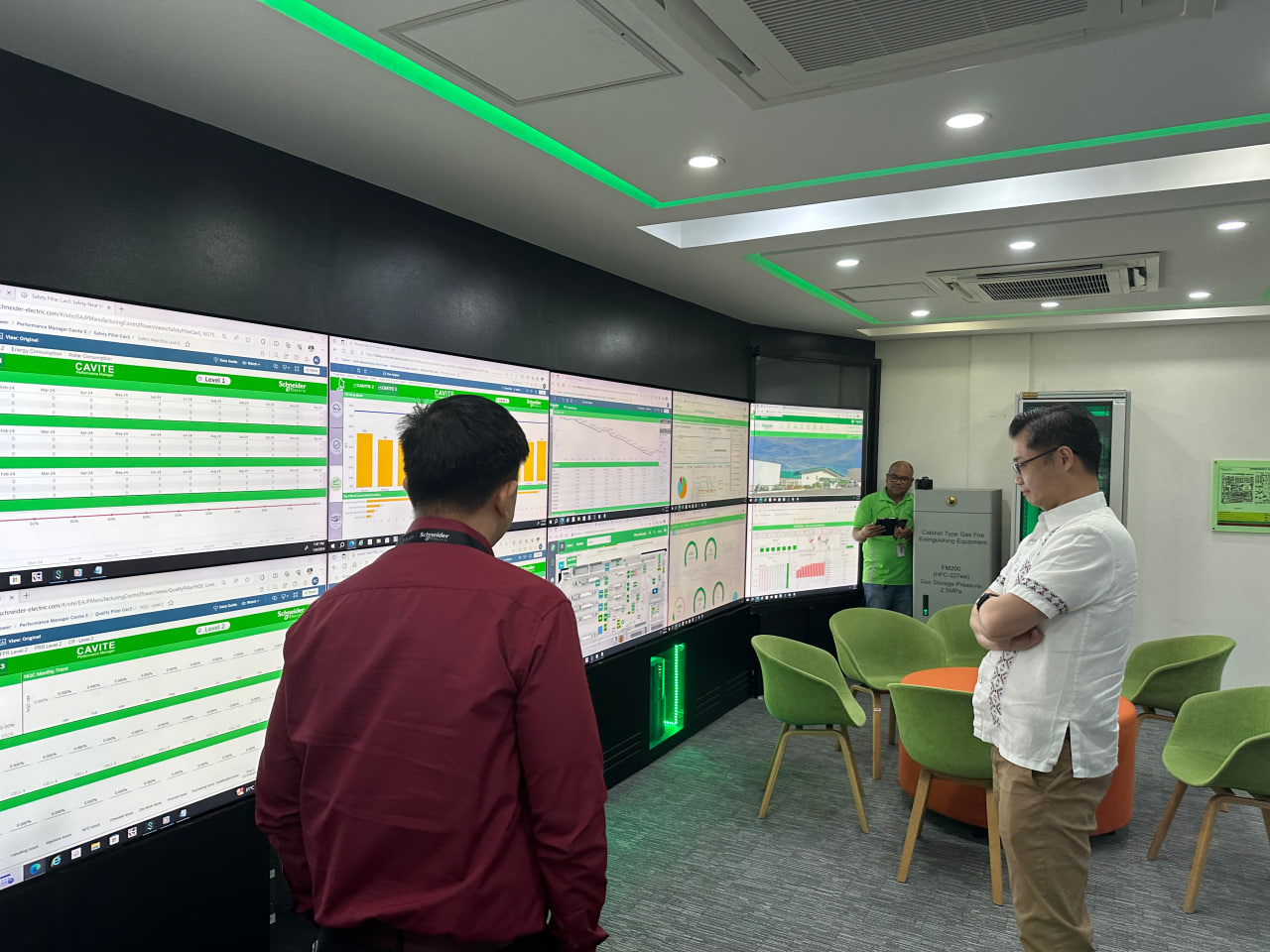
Schneider Electric hosted a tour in its Cavite Smart Factory to demonstrate its smart manufacturing solutions to its partners from the public sector and other stakeholders. (L-R): Yellapa Thimmanna, Business Finance Senior GM of APC, Schneider Electric's flagship brand,  Ejie Tauto-an, Logistics Director of APC, Sen. Sherwin Gatchalian, Chairman of the Committee on Ways and Means, Ricardo Domingo Jr., Digital Transformations Leader of Schneider Electric Philippines, and Atty. Norman Roland Ocana III, Head of Government Affairs of Schneider Electric Philippines

MANILA, January 10, 2024 - Schneider Electric, the leader in energy management and digital automation, reaffirms its commitment this 2024 to help accelerate digital transformation in the local manufacturing sector.

Schneider Electric recently hosted Senator Sherwin “Win” Gatchalian, chairman of the Committee on Ways and Means, in its Cavite Smart Factory. Senator Win Gatchalian was given a tour of the company’s state-of-the art facility that is leading the way in smart manufacturing in the Philippines. 


The factory showcases its innovative end-to-end manufacturing solutions that also leverages its own Ecostruxure™ technology. The company’s proprietary technology focuses on leveraging the Internet of Things (IoT) where organizations can integrate various assets, sensors and other things into an open IoT architecture and software platform. Through this, businesses can achieve better agility, optimized asset performance management, energy efficiency and cybersecurity. Schneider Electric Smart Factories are recognized by the World Economic Forum for paving the way in transforming global manufacturing operations to becoming more efficient and productive through sustainable means. 


Sen. Sherwin Gatchalian explored Schneider Electric’s Smart Factory in Cavite to look into potential digital solutions that can drive sustainability for the manufacturing sector in the Philippines. 


“At Schneider Electric, we remain committed to bringing global solutions to support local industries and manufacturers. Our focus this year is to strengthen our partnerships and harness the power of digitalization and efficiency to build a more sustainable tomorrow for all,” shares Atty. Norman Roland Ocana III, Head of Government Affairs of Schneider Electric Philippines.


Additionally, Schneider Electric is strengthening its collaboration with PEZA to help deliver smart and sustainable solutions to the business sector. This will help place the country at the forefront of industrial digitization and innovation. Last November 2023, Schneider Electric and PEZA launched Go Ecozone, a series of forums that aims to educate PEZA-registered locators on the advantages of green economy. Likewise, it also provides an avenue for the manufacturing sector to share insights and seek support from PEZA on their transformation goals. 


“We will continue to collaborate with the government to deliver cutting-edge, sustainable solutions to power up industries and help boost the economy,” Ocana adds. 

Thursday, May 11, 2023

PEZA Investment Approvals up by 107.15%in April

PEZA INVESTMENT

Pasay City – With strengthened investment promotion and facilitation efforts, the Philippine Economic Zone Authority (PEZA) has recorded an increase of 107.15% in investments for the January to April period.

“From January to April 2023, PEZA has approved a total of 60 new and expansion projects worth Php 33.094 Billion investments, which is 107.15% higher as compared to the Php 15.975 Billion approved investments on the same period in 2022,” reported PEZA Director General Tereso O. Panga.

For the same period, the projects are also expected to generate about US$ 1.012 billion exports and create 7,469 direct jobs.

April Board approval
This comes as the PEZA Board greenlighted 14 new and expansion projects expected to bring in PhP 20.556 Billion investments and create2,233 jobs.

Among these 14 projects, seven (7) are into logistics service enterprise, four (4) into export manufacturing, and three (3) IT enterprises. These projects will be located in Baguio, Cavite, Laguna, Batangas, Cebu, and South Cotabato.

The biggest project pre-qualified by the PEZA Board for FIRB approval is engaged in the manufacturing of biomass fuel products made from Buyo-buyo(Piper aduncum-shrub), with investments worth PhP 19.701 Billion.

Increase in PEZA exports

For the first quarter of the year, PEZA also recorded a total of US$ 15.753 Billion actual exports despite the recent report of the Philippine Statistics Authority (PSA) on widening trade deficit.

Panga said, “In March alone, we have generated US$5.396 billion export revenues which account for 82.65% of the total country's US$6.528 Billion exports in March this year.

Strengthened investment promotions

“We believe that we are now reaping the results of the ongoing investment missions of President Ferdinand Marcos and his administration’s investment initiatives and it is now up to us to follow through the pledges,” explained Panga.

The PEZA Chief noted, “We remain positive that more investments will come to the Philippines withthe big-ticket investments that we secured during the President's visits to Japan, US, and Switzerland among others.”

The US$1.3 billion in investment pledges and 6,700 jobs generated from the President's trip to the US is an indication of the American investors' renewed interest in the country. Based on the investment climate statement on the Philippines by the US Department of State, “The business environment is notably better within the special economic zones, particularly those available for export businesses operated by PEZA, known for its regulatory transparency, no red-tape policy, and one- stop shop services for investors.”

With the recently working visits of the President and his key cabinet and business delegation to the US, UK, Indonesia, Panga stated that, “We hope to attract FDI in advanced manufacturing, EV industry, RE development, mineral processing, regenerative agriculture, and frontier technologies particularly in digital health, fintech, blockchain, AI and big data—to boost our mix of industries and value-adding in the ecozones.” 

Wednesday, April 15, 2020

DTI 4-A’s SSF for Garments Production Manufactures PPE Coveralls for Healthcare Workers


The Department of Trade and Industry-Regional Operations Group (DTI-ROG) and DTI-Region
4A, through its Shared Service Facility (SSF) for Garments Production, collaborated with Reliance
Producers Cooperative in Carmona, Cavite, in manufacturing laboratory gowns, jump suits, and
face masks for the country’s healthcare workers.

The initiative is in response to the call of the Department of Health (DOH) to work closely with the
DTI, industry associations, and private firms to produce personal protective equipment (PPEs)
locally.

Established on April 4, 2017, the Reliance Producers Cooperative is a member of the
Confederation of Wearables Exporters of the Philippines (CONWEP), which has been tapped by
the DOH to produce 10,000 PPE coveralls daily. The Cooperative is the first and only Philippine
Economic Zone Authority (PEZA) registered and authorized to engage in garment manufacturing
and exporting in the Philippines. It has 2,300 member-workers catering a wide range of products
to international customers with distinguished brands.

Since April 8, 2020, Reliance Producers is manufacturing 600 lab gowns, 500 jump suits, and
1,000 face masks per day with 300 member-workers. Upon the arrival of additional raw materials,
they are targeting 5,000 pieces of PPE per day with added workforce.

The DTI 4-A provided ten (10) units of single needle-lock stitch needle feed machine, six (6) units
of over lock five-threads machine, six (6) units of cover stitch machine, four (4) units of buttonhole
machine, and four (4) units of bar tack machine to the Cooperative on June 1, 2016. Presently,
these machines are used to manufacture the PPEs, using raw materials that have met
international standards for waterproofing and resistance to contaminants.

“In this very difficult time, it is vital that we have enough PPEs for our healthcare workers to ensure
their safety in this fight against COVID-19, and we are happy with the support that we are getting
from different sectors. The use of our SSFs to produce more PPEs is our way of helping and
protecting the healthcare workers and other frontliners since they are the ones who are most
exposed to dangers,” said DTI-CALABARZON Director Marilou Toledo.

The SSF Project is a major component of the Micro, Small, and Medium Enterprise (MSME)
Development programs to improve and develop competitiveness among the entrepreneurs by
giving them access to energy efficient technologies and more sophisticated equipment.
Beneficiaries of the project are the actual and potential users of the SSF, which should be
predominantly cooperatives, associations, or groups of MSMEs including individual entrepreneurs
who may not be members of cooperatives, associations, corporations, or organizations.

Thursday, August 8, 2019

Investment Incentives Matter for Industry Development and Jobs generation


With rising globalization and  economic integration through free trade agreements, competition for foreign direct investments has heightened. Even within regional groupings like the EU and ASEAN, countries compete and reinforce their tax and other incentives to attract and influence the decisions of investors especially if all the basic infrastructures and investment climate are relatively similar to each other.  In countries like Thailand and Vietnam, investment incentives contributed to achieve rapid growth. Developing countries would even increase incentives to make up for certain infrastructure handicap or disadvantages.

As DTI Undersecretary Ceferino Rodolfo said, “Not all incentives are wasted, not all incentives are bad.  Incentives are able to attract investments into the country which would not have come in considering the advantages of other countries in terms of infrastructure, cost efficiencies, labor costs or resource availability. Incentives can help compensate for the disadvantages in locating in our country.”

Usec Rodolfo added “At this point, and following President Duterte’s mission to make lives of the Filipinos comfortable, we need all the jobs we can generate, to help uplift their lives out of poverty.

“Investors who have availed of incentives have likewise paid revenues on other tax dues coming from their operations.  Taxes were paid such as on withholding taxes from salaries, VAT, real estate taxes and the net effect is positive revenue contribution to the government”, Rodolfo said.

Based on TIMTA data from 2015 to 2017, the top ten PEZA enterprises paid total taxes of P45.3B while income tax incentives availed amounted to P45.1B resulting in a net revenue position of P0.2B.  Their exports which accounted for 22% of the country’s total reached US $40.7B in the same period. Their local purchases totaled P110.1B. In the same period, number of workers per year averaged 165,300.

Rodolfo cited that one high-tech electronics company posted a cumulative net tax revenue of P3B during its presence in the Philippines from 1981-2018, as its total taxes paid stood at P5.2B versus its income tax incentives availed of P2.2B.  During the period, exports totaled $3.9B, local purchases of P22.2B, salaries and wages paid amounted to P67.6B while employment expanded from 3,378 workers in 1990 to 24,222 in 2018, just for that company.

According to Rodolfo, in terms of BOI income tax holiday, companies also contribute revenues to government in the form of other taxes paid and the ratio is around 1:4.7 or for every one peso incentive, the companies pay around P4.70 for other taxes.   In 2017, the BOI Total Incentives Availed was Php27Bn; but Total Taxes Paid was Php128Bn. More importantly, BOI incentives are time-bound. After 4yrs, there is no foregone revenue but the Tax Payments continue on.

Based on the above, Rodolfo concluded that “incentives do not all result in leakages.  They definitely result in investments, job creation, expansion of domestic capacities and Net positive revenues to government.  So let us manage the transition period better.”

He reiterated the DTI Secretary’s position that “We are for the tax reform proposal especially in making the incentives timebound but we have to carefully manage the transition, and not rush the cutting of incentives such as the 5% GIE that we promised to the PEZA locators. Affected exporter-locators have expressed concern that the change in the system may compel them to redirect their expansion plans elsewhere and even risk the possible transfer of their current operations to other countries.  There is a risk and we should minimize all the risks as we need all the jobs we can generate.


We should therefore be careful in the transition for those who are 100% exporters and labor intensive and are paying more than what they receive in terms of incentives. We also need to take into account innovative companies that are upgrading their products and moving up the value chain along with companies whose activities address gaps in and whose operations are crucial to the supply or value chain or activities that would increase competition in the domestic market.”

Specifically we should consider a 5-10 year range of transition.  In the meantime, the GIE can also be brought up to 8% so there can be an immediate additional revenue that can help balance the planned reduction in Corporate Income Tax.

Friday, August 2, 2019

DTI: New Technologies Will Not Lead to Job Loss but Will Bring in New Types of Jobs, Better Productivity


Trade and Industry Secretary Ramon Lopez dispelled fears over possible job losses due to the emerging new technologies in various industries.

"Technology leads to innovation and new approach in doing things. It won’t always lead to loss of jobs but rather provide opportunities for the industry to increase productivity and introduce new high-paying jobs for Filipino workers. We should welcome it and be ready to adapt to this phase of industrialization. In fact, continuous innovation is needed if companies are to remain competitive," said Sec. Lopez.

The Department of Trade and Industry (DTI) chief acknowledged technology is essential to improve efficiencies, and productivity.  He also noted that upskilling is an important adaptive strategy for Filipino workforce to remain in demand in any type of business.

"People will have to be upskilled and retrained to upgrade their current skills and acquire new ones to remain relevant.  There are current programs integrating new skillset requirements with schools and training centers to prepare the students and the current workforce. Many companies also provide upskilling and retraining programs as well as apprenticeship opportunities," shared Sec. Lopez.

The trade chief emphasized that technology change is not just happening now as there have been different periods of industrialization-- from the first to the fourth Industrial Revolution-- where forms of jobs changed but the human labor market remained relevant and needed. This started with manual labor to produce things, leading into the advent of mass production and concepts of having production lines where workers learned how to run and work with machines.

Sec. Lopez underscored that when people worked with machines, jobs were not lost as it opened other areas of employment such as manufacturing, servicing, and maintenance of machines.

He cited the entry of automated teller machines (ATMs) in banks as an example, noting that there was a fear back then that bank tellers would lose their jobs. As of today, bank tellers are still present and needed with more value added functions, focusing on account management and customer service. Jobs were not lost since the ATMs also serve the transaction needs of customers 24/7, beyond office hours and tellers were not performing these tasks anyway. Thus, the use of ATMs provided greater customer service and better productivity.  Sec. Lopez added that the loading of cash in each ATM as well as its maintenance still require human labor.

The coming of internet and connectivity brought a lot of new opportunities in e-commerce, more buyer-seller platforms such as Airbnb, eBay, Grab, and tons of opportunities such as Youtube-ing, in game development and gaming, digital advertising and networking.

"The case of ATMs is the same with the advent of robots and mechanization, which usually perform repetitive, dangerous or high-precision jobs.  Humans are still needed to design, manufacture, program or train the system software and maintain the robots" Sec. Lopez added.

In the era of Artificial Intelligence (AI), chatbots and data analytics, the trade chief said that new skillsets are required. Many things are happening and bound to change. Some systems are now AI-enabled, making the jobs of people easier. But people are also the ones developing and maintaining the AI systems.

Upon consultation with AI industry experts, Dado Banatao and George Yang of AI-Pros, the DTI Secretary noted that the use of AI in the Business Process Outsourcing (BPO) industry is a win-win for both the industry and Filipino workforce. While AI is cost-effective for completing multiple tasks faster and with less error, it will also allow the human workforce to increase their competitiveness in performing tasks ranging from simple to complex within the same timeframe, which are high-value and high-paying tasks.

"By combining the sizeable Filipino workforce possessing the appropriate skills and talents with AI-powered technologies, the Philippines will be poised to be the AI-driven BPO capital of the world," said Sec. Lopez.

“We are now seeing people in the BPO industry operating AI-enabled systems, where previously rejected job seekers in BPOs are now finding themselves with more job opportunities to do simpler tasks in operating AI-enabled systems. We’ve seen BPO operations in Manila where AI and chatbots are the first line of contact of clients. However, these were managed by a human operator, who is also now capable of managing two or three simultaneous calls attended by the AI-enabled system,” shared the trade chief.

According to George Yang, AI also widens the reach of opportunities to the underprivileged, citing that even high school graduates, market workers, or street vendors can be trained to operate AI-enabled systems. The most vital requirement is just the ability to understand and speak English, which Filipinos are very good at.

"Such is an example where technology can even make the opportunities more inclusive.  Yes, there are challenges but there are more opportunities. Our education and training systems, including TESDA, are now offering training programs to enable our workforce to catch up on the new job trends and prepare them for the ever-changing technology. But we're confident that we can achieve this goal of creating job and employment opportunities that are more inclusive even in the future,” Sec. Lopez concluded.

Tuesday, November 22, 2016

Malaysia, Middle East, China, Russia, Japan investors invited for PEZA’s SEZs


Numerous companies of Malaysia, the Middle East, China, Japan and others are now in discussions and being invited to invest in the Philippines’ tax-free industrial, agricultural, tourism, forestry, defense industry and other Special Economic Zones (SEZs) “due to President Rody Duterte’s new independent foreign policy to make the Philippines a friend of all countries and enemy of no one”, said the new director-general of Philippine Economic Zone Authority (PEZA) Dr. Charito “Ching” B. Plaza on November 21 at the Pandesal Forum of 77-year-old Kamuning Bakery Café in Quezon City.

            PEZA Director-General Dr. Plaza said that the Philippines traditionally received foreign investments in the past from the United States and its allies like Japan and the West, but now investors and governments of other countries in the Middle East, Russia, China and other regions are also being invited to invest in the fast-growing economy of the Philippines. She said these defense industrial complexes can rise in Bataan, Zambales, Palawan, and at least in two areas of Mindanao. 

Plaza said the Duterte government also has a bold vision to transform some of the country’s islands into self-contained SEZs which can become future cities.  

            Plaza said officials and members of royal families United Arab Emirates and Qatar have expressed interest to lease land here for 75 years for possible agricultural and oil refinery projects, with one interested group even asking for as much as a million hectares of agricultural land in exchange for part of the venture’s profits to be donated as social development projects and schools. Dr. Plaza mentioned that among those she had discussed possible SEZ investments was Sheikh Al Thani of the respected Qatari royal family. One possible major SEZ project is the creation of a halal food processing hub in Davao, in Mindanao, southern Philippines. 

            PEZA Director-General Plaza added that they are also proposing the creation of defense industry SEZs with countries like Russia, China, Israel, South Korea or others. She added that these defense industrial complexes will not only boost economic development, they can also strengthen the Philippines’ national defense and manufacturing capabilities. Plaza had the rank of brigadier general in the military reserve force.

            Dr, Plaza added that President Duterte’s economics-focused diplomacy and independent foreign policy are boosting our ties with Asean and Asian countries, with Malaysian investors expressing interest in undertaking business ventures in the Philippines such as a large-scale palm oil planation and milling project.

            PEZA Director-General Dr. Charito Plaza said the Duterte government’s pro-poor priority shall encourage more foreign and also Philippine investors to do business in the poorest and neglected yet resource-rich rural regions of the country such as in Mindanao and the Visayas.