Showing posts with label Kabalikat sa Kabuhayan. Show all posts

Saturday, April 27, 2024

Farming Futures


While modern agricultural techniques boost yields for some, there remains a number of Filipino farmers who struggle to keep pace. These experienced hands find themselves falling behind in a market demanding higher production, clinging to familiar yet often inefficient methods passed down through generations.


One farmer from Pampanga, Jayson Garcia, sought to disrupt this prevailing narrative in his family. He knew that he had to chart a new course forward for his farm and innovate to remain competitive within the rapidly evolving landscape of modern agriculture.


“Noon, mahirap ang magtanim,” he recalled their life before joining SM Foundation’s Kabalikat sa Kabuhayan. “Para bang tsambahan, basta pag itinanim mo ‘yan, hintayin mo na lang mamunga. Mas mahirap pa lalo kapag nagkaroon ng kalamidad,” he added.


SM Foundation’s training program focused on high-value crop cultivation was the breakthrough Garcia needed to revitalize his farming techniques. These included selecting the best seeds and caring for them as well as strategic planting schedules.
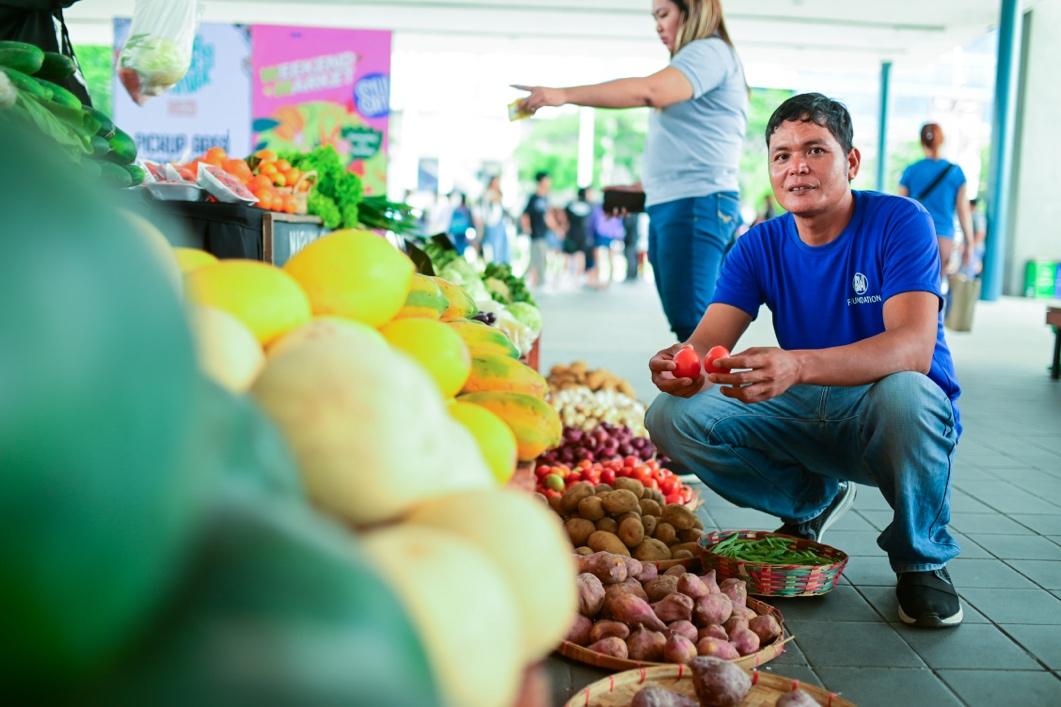

Jayson attends the SM City Clark’s Weekend Market to observe best practices and gain insights into new agricultural techniques.

The livelihood program also gave way for him to discover alternative sales channels that enhanced his earning potential while extending fair prices to his customers. The knowledge and confidence he gained led him to expand his farm, and in effect, increased his monthly income to more than Php25,000.

Aside from directly selling his harvests, he is now planting a variety of vegetables–on his farm, including lemongrass, malunggay, and madre de cacao, which he sells online to small businesses that process the produce into other products. 


Embracing new techniques


Sharing the same story of hope is another KSK farmer from Pampanga, Juanito Dela Cruz. Despite his age, he actively pursued and adopted modern farming techniques. Building on his current success, he shared the importance of adaptability for farmers, calling for others to try and explore new practices.


From a modest monthly income of Php10,000, Juanito experienced an upsurge in his earnings, notably through participation in the Weekend Market at SM City Clark, yielding around Php30,000 weekly. “Kailangan maging bukas tayo sa makabagong pamamaraan ng pagsasaka para makahabol tayo sa demands ng panahon ngayon—ito ang itinuo sa akin ng SM Foundation-KSK,” he said. 
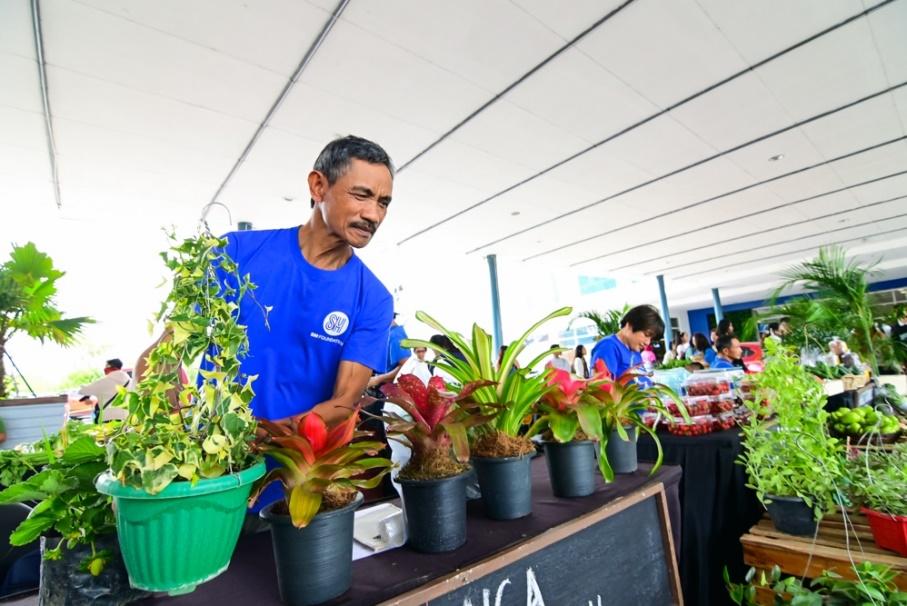

Juanito, alongside his wife, actively participates in the SM City Clark Weekend Market. They credit the market with contributing to their increased profitability.


The SM Group’s KSK program has changed the lives of roughly 30,000 Filipino farmers, including Jayson and Juanito. Through its initiatives, farmers who once lost hope have been able to embrace modern farming techniques, leading to adaptability in the face of the evolving agricultural landscape.


The SM Group, through SM Foundation, remains steadfast in its commitment to spreading social good. This dedication extends to SM’s forthcoming endeavors to be led by its future smart city property development – with focus on enhancing positive social impact in the communities where SM operates.

Friday, June 17, 2022

Collaboration: A Key in Creating Sustainable Agri-Enterprises

Kabalikat Sa Kabuhayan

Limited market information and market access are two major obstacles to increased smallholder farmers’ income. According to studies, farmers in grassroot communities often lack access to profitable, value-added markets. In the absence of critical supporting functions, such as infrastructure and service provision – farmers struggle to transform their traditional subsistence farms into a feasible commercially oriented production. Buyers, on the other hand, such as wholesalers, find it difficult to get the quantity and quality of produce that they need for processing on a timely basis. Because of this challenge, SM Foundation collaborated with various government agencies, and engaged various SM business units such as the SM Development Corp. (SMDC), SM Supermalls and SM Markets to ensure that local farmers under the Kabalikat Sa Kabuhayan (KSK) program have venues where they can sell their produce amid the COVID-19 pandemic.

From training KSK participants in practicing sustainable farming technologies via technology transfer and product development, SMFI, together with various SM business units used the power of collaboration to create farm-market linkage - which intends to create a powerful driver of rural poverty reduction.


Team social good

The Good Guys Market is a weekend market set up in SMDC properties to connect small-scale farmers directly with consumers—condo residents. This initiative links around 26,000 small-scale farmers directly with consumers.


Together with SM Supermalls, SMFI launched the Green Lane initiative. Led by the wives of the KSK farmers, the social enterprise offers a wide variety of quality yet affordable indoor and landscape plants which cater to every enthusiast’s preference. In addition, the team also launched the KSK Farmers’ Market Day to provide farmers with market exposure in select SM Malls nationwide.


Meanwhile, SMFI also partnered with SM Markets in creating market for onion farmers. Through the partnership, SMFI was able to establish specialized onion pop-up booths creating a stable market for small scale onion farmers.


Millions of smallholder farmers are seeking ways to improve the productivity of their farms and to improve their market performance. Modern farming technologies, paired with market linkage, such as the SM KSK, plays a vital role in improving the livelihood of small-scale farmers and their families.


SM Foundation’s Kabalikat Sa Kabuhayan (KSK) is SMFI’s Social Good program on sustainable agriculture that intends to uplift the lives of Filipinos in grassroot communities through sustainable agriculture via technology transfer, product development and farm-market linkage. To date, the program has trained more than 28,500 farmers from more than 900 cities/municipalities nationwide.


###

Friday, March 25, 2022

Empowering Communities through #SocialGood

SM #SocialGood

The private sector plays a significant role when it comes to economic growth in the Philippines by generating more jobs and contributing to our gross domestic product (GDP). Beyond that, it is also considered to be a driving force for inclusive and sustainable development in the country as more and more businesses employ corporate social responsibility (CSR) initiatives to address social and environmental concerns within the communities where they operate.

By helping improve the quality of life of the people in these host communities, business is able to flourish. As such, CSR has become a key pillar of successful business management through the years. SM’s visionary founder, Henry “Tatang” Sy, Sr., put it best in his principle that social development and investment go hand in hand with business growth to achieve a better future.

The SM group has embraced the responsibility to contribute to nation building through its social good arm, the SM Foundation, Inc. (SMFI). For nearly four decades, we have focused our resources, time, and reach to ensure that we are able to create opportunities wherever SM is present through social good programs that are geared towards quality education, sustainable agriculture, healthcare, and disaster response.

SM Empowering Communities

Anchored on Tatang’s belief that education is the greatest equalizer, SMFI established the SM Scholarship Program in 1993 to provide the youth access to quality tertiary and vocational education. We believe that through our scholarship grants, SM will be able to contribute to eradicating the intergenerational poverty cycle by granting scholarships to economically challenged but deserving students. And to complement this and more importantly, to address the challenges being faced by our public school system, SMFI, together with social good partners such as SM Prime, we have provided school buildings equipped with key facilities and equipment to underserved communities.

Another social good pillar of SMFI is sustainable agriculture that aims to address the dilemma of the aging farmer population in the country as well as the growing gap between supply and demand for local food sources. In 2007, the foundation launched the Kabalikat sa Kabuhayan (KSK) program to bring modern and sustainable farming skills and linkages in both rural and urban communities, empowering farmers to have food on their table and creating market linkage to provide them with economic opportunities.

Accessible healthcare and timely disaster response are also at the heart of the foundation’s advocacy. Through its Health and Wellness program, SMFI helps address the shortage of quality healthcare facilities in the country by constructing and upgrading health centers in host communities supplemented by medical mission activities nationwide. The Operation Tulong Express (OPTE), on the other hand, gives immediate assistance in the form of relief goods and medical services in collaboration with SM Supermalls and SM Markets to communities affected by calamities and disasters that frequently occur in the country.

During the onset of the Covid-19 pandemic in 2020, SMFI was one of the first organizations to assume an active role in assisting in the pandemic response by expanding the reach and impact of the Health and Wellness program and utilizing its partnerships to extend a helping hand to frontliners and Filipinos nationwide, especially those in SM host communities.
Through these social good programs, we continuously aspire to be a development partner for our host communities and serve as model for other organizations in terms of bringing social development specially in areas where they operate.

Implementing CSR involves a dynamic learning process given that social and environmental good are moving targets – and these cannot be fully achieved through one-time activities and decisions. Instead, companies should view and approach CSR as a process of continuous improvement that involves being constantly alert to new issues and considerations, which can be achieved through consistent community consultation and engagement.

And contrary to the notion that CSR is only an approach for large corporations and multi-national businesses, small and medium-scale enterprises can also have the means to benefit their respective communities in their own ways. In fact, they are more likely to effectively facilitate local-level CSR programs as they are more deeply embedded in their communities. Examples of these include sourcing of raw materials from community-based suppliers, matching and encouraging charitable work by employees, and even as simple as going paperless in their daily business operations.

CSR programs, no matter the size or scale, are valuable to the communities they are serving because of their pivotal role in promoting sustainable, just, and balanced development, and contribution in addressing social and environmental challenges.