Showing posts with label #Livelihood. Show all posts

Thursday, January 29, 2026

Vena Energy Turns Over 1,000 “Seats for Sustainability” to Talim Island Schools, Improving the Learning Environment for Students While Creating Livelihood for Locals

[Philippines, 27 January 2026] Vena Energy, a leading green energy solutions company in the Asia-Pacific region, has successfully turned over 1,000 handcrafted armchairs to elementary schools in the municipalities of Binangonan and Cardona on Talim Island.

The initiative, titled, “Seats for Sustainability,” was led by Vena Energy’s subsidiary, Island Wind Energy Corp. (IWEC). It marks a significant milestone in the company’s corporate social responsibility (CSR) efforts, delivering a dual impact: improving the learning environment for thousands of students while providing sustainable livelihood opportunities for the island’s residents. 

Empowering Education in Remote Communities
The turnover ceremonies were held on 22 January 2026 at Kasile Covered Court (Binangonan) and 23 January 2026 at Lambac Covered Court (Cardona). The donation benefits multiple schools, including Kasile Elementary School, Bombong Elementary School, Kinagatan Elementary School, and Lambac Elementary School. 

For remote areas like Talim Island, logistical challenges often hinder the delivery of school facilities. This donation addresses a critical infrastructure gap, ensuring that students have access to comfortable, DepEd-standard furniture that fosters a better learning environment. 

From Skills to Livelihood
What sets the “Seats for Sustainability” project apart is its commitment to the local circular economy. Rather than sourcing furniture from external suppliers, Vena Energy partnered with local communities to manufacture the chairs.

Residents were trained by the Technical Education and Skills Development Authority (TESDA) in carpentry and craftsmanship. Following their training, these local community members were hired by Vena Energy to build the 1,000 chairs. This not only ensured the furniture met quality standards but also injected income directly into local households, turning a charitable donation into a driver for economic empowerment.

A Commitment to Host Communities
“Seats for Sustainability” aligns with Vena Energy’s broader CSR strategy, which prioritizes Education, Infrastructure Development, and Community Well-being. By engaging the community in the solution, the company reinforces its core value of enabling sustainable social and economic development within its host communities.

“We believe that  a community means giving them thempoweringe necessary tools to build their own future,” said Samrinder Nehria, Head of The Philippines at Vena Energy. “This project is special because the fathers and neighbors of these students built the very chairs their children will sit on. It is a story of pride, resilience, and sustainability.” 

The event was attended by key stakeholders, including representatives from IWEC, local government officials from Binangonan and Cardona, school officials, and residents of Talim Island.

Tuesday, September 23, 2025

Mulanay: Finding ‘Paraiso’ Through Digital Empowerment for Persons with Disabilities


The town of Mulanay in Quezon province has come a long way from the underserved rural community portrayed in the 1996 award-winning film Mulanay: Sa Pusod ng Paraiso, directed by Gil Portes. While the movie depicted a village lacking in infrastructure and a community deeply rooted in tradition and reluctant to embrace modern medicine, present-day Mulanay is now a first-class municipality where diversity and inclusion thrive, opening opportunities for residents in challenging circumstances such as persons with disabilities.


These opportunities pave the way for programs that uplift Mulanay’s most vulnerable sectors, including a partnership that the local government, through the Municipal Social Welfare and Development (MSWD) office, forged with ATRIEV, PLDT, and Smart to train residents with disabilities on the basics of entrepreneurship and the use of digital innovations to grow their businesses. This partnership aligns with the PLDT Group’s Inclusion, Diversity, Equity, Advocacy through Technology (IDEATe) program.


“As a father to a child with autism, I understand the challenges that persons with disabilities face,” said Mulanay Mayor Aristotle Aguirre. “That is why we are working with like-minded organizations to provide them with digital skills and entrepreneurial opportunities, so they can start or grow their own businesses and thrive in today’s economy.”


Conducted by ATRIEV and also supported by NORFIL Foundation, more than 20 persons with disabilities and carers of persons with impairments attended the Digital Business Basics Training (DBBT). The eight-day workshop was divided into two modules. The first focused on starting a business, covering essential topics such as branding, connecting with target markets, fund sourcing, and pricing and costing strategies.


Sergio Macarang, 55, saw his clients dwindle after he got into a vehicular accident that limited his mobility. He was a construction foreman prior to the accident. He turned to selling medical masks and wipes to supplement his income. And now, he wants to grow his business.


“You need careful planning,” Macarang said. “You have to learn proper costing, so you don’t end up selling your products at a loss.”


Pricing was also the most important skill for 26-year-old Jerald Regencia, a reseller of beauty products born with physical impairments. “I was intimidated at first because I have forgotten my Math,” he recalled. “But I brushed up on my Math skills to ensure that I am earning from my business. You have to factor in all your expenses.”


The second module gave participants hands-on experience using digital tools and social media platforms to expand their reach, such as setting up Facebook and Tiktok accounts and creating content for their pages.


“I was even able to design a logo for my business using a mobile app,” Macarang added. “Through Facebook and other online platforms, I can now reach more people and potential customers. My business is no longer limited to foot traffic on our street — it has grown beyond our community.”


“Selling online has really made things easier for me,” Regencia shared. “Before, I had to personally visit my suki to show them new items or ask if they wanted to order again — which wasn’t easy because of my condition. Now, I can just promote my products online and connect with them through messaging apps.”


Through inclusive initiatives like this, the stories of persons with disabilities in Mulanay are moving toward brighter chapters. Equipped with digital skills and business know-how, their journeys are only just beginning.


“At PLDT and Smart, we believe that technology is a powerful equalizer,” said Stephanie Orlino, AVP and Head of Stakeholder Engagement Team. “Through programs like IDEATe, we are opening doors for persons with disabilities to participate fully in the digital economy, giving them the tools and opportunities to improve their lives and contribute meaningfully to society.”


IDEATe activities are aligned with PLDT and Smart’s commitment to help the country achieve UNSDG 8 on decent work and economic growth, and UNSDG 10 on reducing inequality by empowering and promoting the social, economic and political inclusion of all, including persons with disabilities.

TP, TESDA Launch Training Program for Work-Ready Mear-Hires

Negros Occidental, Philippines – TP in the Philippines, a global leader in digital business services, was recently recognized as one of the pioneering enterprises in Negros Occidental to register as partner in Enterprise-Based Education and Training (EBET), a flagship program of the Technical Education and Skills Development Authority (TESDA). 

With the implementation of the EBET Framework, TESDA aims to strengthen workforce development through enhanced skills training, improve employability, and bridge the gap between the education sector and the IT-BPM industry.

As an enterprise partner, TP will help implement the Near-Hire Communication Training Program. This 10-day, TESDA-accredited course is designed to develop work-ready communication skills for near-hires, equipping them for potential careers within the organization. This initiative also supports TESDA’s drive to expand university-industry collaboration, ensuring that Filipino workers are trained with skills that meet global market demands.

The training program’s curriculum features two modules: “Communication 101” and “Call Center 101.” The first module focuses on technical articulation—including pronunciation, grammar, thought organization, and conversational confidence—while the second primes students for the specific contact center environment.  The curriculum immerses them in the practical realities of the customer service experience such as call flows, scripting, active listening, empathy, and problem-solving.

Graduates of the program will emerge work-ready and equipped with the practical skills and confidence needed to succeed in the country’s fast-growing customer service sector.

“This program goes beyond skills training, giving students a tangible gateway as they step into meaningful careers in the IT-BPM industry,” said Jeffrey Johnson, Chief People Officer of TP in the Philippines.

TESDA likewise underscored the importance of this partnership. “By registering programs under EBET, you are ensuring that our trainees are not only competent, but also industry-ready. Enterprises can now dictate what skills and competences they need, and TESDA now needs to respond as flexibly and quickly as we possibly can to be able to respond to a volatile, complex, and ambiguous world of work. TP’s commitment makes it possible for our learners to bridge the gap between the classroom and the real demands of the workplace,” said TESDA Director General Jose Francisco Benitez.

“Through this program, we are able to see the EBET in motion, and we are grateful to our partners for helping make our vision of an empowered work-ready youth come to life,” added NiƱa Connie Dodd, TESDA Negros Island Region (NIR) Interim Regional Director.

The Near-Hire Communication Training Program, among other initiatives, reaffirms TP in the Philippines’ commitment to workforce development and talent empowerment, upholding its position as one of the country’s top employers. By working hand-in-hand with TESDA and Bacolod City College, TP demonstrates the power of industry, government, and academe collaboration in opening career pathways for the youth and building stronger local communities. 

Tuesday, September 16, 2025

Load Up, Level Up Smart Supports Sustainable Livelihoods through Digital E-Loading


For many Filipinos, selling mobile load is more than just a side hustle, it’s a lifeline. To make mobile load more accessible through the Hatchiko app, mobile services provider Smart Communications, Inc. (Smart) is enabling PLDT Employees Multi-Purpose Cooperative (TELESCOOP) members to earn extra income through a streamlined, digital e-loading experience.


“At Smart, we believe that technology should uplift lives,” said Smart Assistant Vice President and Head of Key Accounts Modern Trade Christian So. “By making load accessible through Hatchiko and TELESCOOP, we’re helping everyday earners build small but more sustainable side businesses, supported by our expanding 4G and 5G network.”


The Hatchiko app simplifies e-loading operations, allowing users to manage transactions, monitor earnings, and serve customers—all from their mobile phones. It’s a practical way to supplement income and reach more customers without needing a storefront. Hatchiko offers a range of services for its users, including solutions to integrate platforms, manage bulk transactions, or process e-load.


“Our goal is to reshape how load reselling works by offering a digital platform that simplifies the entire process,” said Bill Vergel Mendoza, President of Hatchiko. “Through the Hatchiko app, we’re empowering individuals with tools that make loading more efficient, transparent, and scalable—so they can manage their transactions with ease and grow their businesses sustainably.”


TELESCOOP, a long-standing cooperative serving PLDT employees and affiliates, has embraced digital transformation to better serve its members. Making Smart load accessible through Hatchiko adds a new income stream to its growing suite of digital services.


“This gives our members a meaningful opportunity to grow their income,” said Benedicto Portugal, Chairperson of TELESCOOP. “It’s a small shift with a big impact—especially for those looking to build something of their own.”

Smart e-load has been one of the fastest selling products for resellers and retailers across the country since it was introduced in 2003. A world-first innovation in mobile communication, Smart e-load marked the birth of prepaid services, democratizing access to mobile communication for Filipinos and enabling easier communication across the nation and overseas.


As Smart continues to expand its network nationwide, this initiative reflects its commitment to inclusive growth—where technology becomes a tool not just for connection, but for progress.

Friday, August 8, 2025

Kuya Kim Takes On MOVE IT’s Rider Onboarding, Proves It’s No Easy Pass

Manila, Philippines, 08 August 2025 – Homegrown motorcycle taxi platform MOVE IT, as part of its commitment to the high standards of road safety and industry-leading driver quality, teamed up with veteran journalist and motorcycle enthusiast Kuya Kim Atienza to have him personally experience the rigor of the platform’s driver assessment and onboarding process.
Known for his love of motorcycles and dedication to public service, Kuya Kim went through MOVE IT’s six-step rider onboarding program — proving firsthand that MOVE IT doesn’t hand out Ka-MOVE IT gear lightly.
In a recent vlog he posted on his Facebook page, Kuya Kim showed how he endured the six-part MOVE IT driver assessment process: 
-Document Screening: MOVE IT mandates 100% compliance for aspiring riders — including NBI, police, and CIBI clearance. - - All aspiring MOVE IT riders are required to undergo drug and health testing upon application and every six months thereafter.
- Vehicle Inspection: All units must pass roadworthiness checks aligned with standards of the Motorcycle Taxi Pilot Study.
- Skills Assessment: Kuya Kim took on real-world riding tests, including backriding drills, vehicle control, and road-readiness evaluations.
- Training & Orientation: He sat in a classroom session that covered road safety protocols, passenger service, and app navigation. Riders are also required to undergo an annual mandatory retraining program. 
- Account Activation: Only after clearing all prior stages is a rider's account activated.
- Gear Release: MOVE IT provides free, high-grade safety gear as part of its commitment to professionalizing moto-taxi riding. 

The Verdict: Even a veteran like Kuya Kim had to earn his stripes.
Alongside the vlog, Kuya Kim also unveiled I-Sumbong Mo sa MOVE IT — a new, accessible feedback channel on Facebook Messenger that lets passengers report safety-related concerns and driver-focused experience. This complements existing tools like in-app ratings and the “Report an Issue” feature.

Saturday, April 27, 2024

Farming Futures


While modern agricultural techniques boost yields for some, there remains a number of Filipino farmers who struggle to keep pace. These experienced hands find themselves falling behind in a market demanding higher production, clinging to familiar yet often inefficient methods passed down through generations.


One farmer from Pampanga, Jayson Garcia, sought to disrupt this prevailing narrative in his family. He knew that he had to chart a new course forward for his farm and innovate to remain competitive within the rapidly evolving landscape of modern agriculture.


“Noon, mahirap ang magtanim,” he recalled their life before joining SM Foundation’s Kabalikat sa Kabuhayan. “Para bang tsambahan, basta pag itinanim mo ‘yan, hintayin mo na lang mamunga. Mas mahirap pa lalo kapag nagkaroon ng kalamidad,” he added.


SM Foundation’s training program focused on high-value crop cultivation was the breakthrough Garcia needed to revitalize his farming techniques. These included selecting the best seeds and caring for them as well as strategic planting schedules.


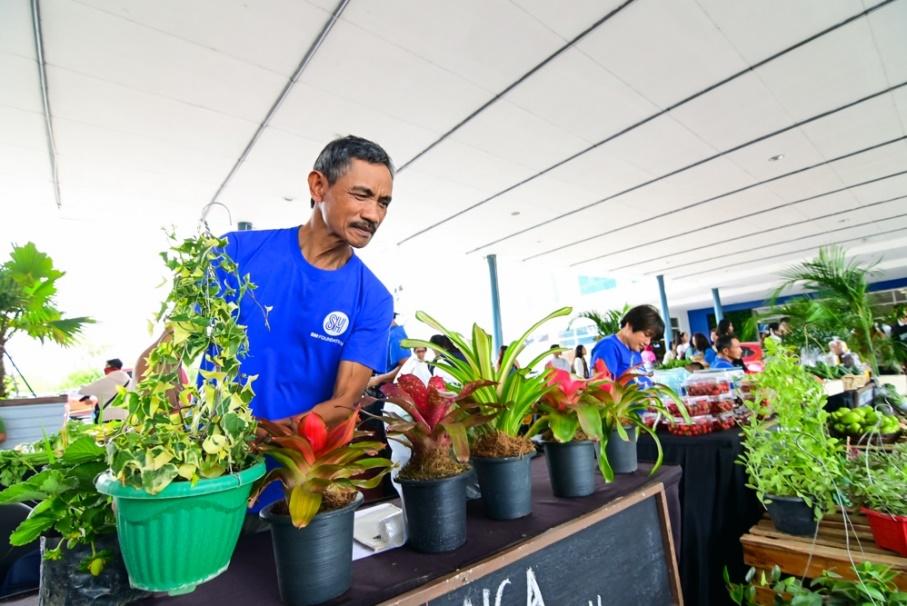
Jayson attends the SM City Clark’s Weekend Market to observe best practices and gain insights into new agricultural techniques.

The livelihood program also gave way for him to discover alternative sales channels that enhanced his earning potential while extending fair prices to his customers. The knowledge and confidence he gained led him to expand his farm, and in effect, increased his monthly income to more than Php25,000.

Aside from directly selling his harvests, he is now planting a variety of vegetables–on his farm, including lemongrass, malunggay, and madre de cacao, which he sells online to small businesses that process the produce into other products. 


Embracing new techniques


Sharing the same story of hope is another KSK farmer from Pampanga, Juanito Dela Cruz. Despite his age, he actively pursued and adopted modern farming techniques. Building on his current success, he shared the importance of adaptability for farmers, calling for others to try and explore new practices.


From a modest monthly income of Php10,000, Juanito experienced an upsurge in his earnings, notably through participation in the Weekend Market at SM City Clark, yielding around Php30,000 weekly. “Kailangan maging bukas tayo sa makabagong pamamaraan ng pagsasaka para makahabol tayo sa demands ng panahon ngayon—ito ang itinuo sa akin ng SM Foundation-KSK,” he said. 


Juanito, alongside his wife, actively participates in the SM City Clark Weekend Market. They credit the market with contributing to their increased profitability.


The SM Group’s KSK program has changed the lives of roughly 30,000 Filipino farmers, including Jayson and Juanito. Through its initiatives, farmers who once lost hope have been able to embrace modern farming techniques, leading to adaptability in the face of the evolving agricultural landscape.


The SM Group, through SM Foundation, remains steadfast in its commitment to spreading social good. This dedication extends to SM’s forthcoming endeavors to be led by its future smart city property development – with focus on enhancing positive social impact in the communities where SM operates.

Monday, April 1, 2024

DTI-Laguna Conducts Livelihood Orientation Seminar to CMDC’s Graduates and Trainees

DTI-Laguna Conducts Livelihood Orientation Seminar to CMDC’s Graduates and Trainees

Calamba City — On March 22, 2024, the Calamba Manpower Development Center (CMDC), in collaboration with the Department of Trade and Industry – Laguna Provincial Office (DTI-Laguna), through its Negosyo Centers, spearheaded a livelihood orientation seminar for the graduates and trainees of CMDC held at 3rd floor lobby, New City Hall, Calamba City, Laguna. It was attended and participated in by 262 graduates and trainees from different courses.

The said livelihood orientation program commenced with an opening prayer led by Ms. Zenisa Alinsunurin, followed by the welcome remarks delivered by Mr. Crisolo Gamboa, Senior Manpower Development Officer.

Continuing with the program, Ms. Avegail Agojo, Business Counselor from Bay, led a discussion on how to start a business. She discussed the pros and cons of managing a business based on ownership, as well as the step-by-step process of starting a small business.

Following Agojo’s presentation, Ms. Rica Mae Garcia, Business Counselor from Majayjay, tackled business ideas. She presented some small business ideas and the required capital needed to start them, along with the type of business they want to engage with.

Livelihood Orientation Seminar

The third speaker, Ms. Michelle Caymo, Business Counselor assigned in Nagcarlan, talked about the programs and services offered by the Department, as well as the two (2) divisions it has and their specific functions.

Next, Garcia imparted knowledge on consumer education, specifically addressing the consumer’s eight (8) rights and five (5) responsibilities, which should be practiced and exercised by every consumer.

Lastly, Mr. Carl Eric Villanueva, Business Counselor from Magdalena, provided information on the difference between business and entrepreneurship and the characteristics and traits an entrepreneur must possess. He also named some entrepreneurs who experienced failures and hindrances but remained successful in operating their businesses nowadays.

The event concluded with a question-and-answer portion wherein participants were able to clarify some points and share their insights.

Overall, the seminar received positive comments from the participants and they expressed their satisfaction with the learning activity.