Showing posts with label #EDSA. Show all posts

Wednesday, January 7, 2026

Haier Lights Up EDSA with Paris Saint-Germain Partnership to Welcome 2026

Manila, Philippines — Global home appliance brand Haier welcomed the new year by bringing the spirit of world-class football to Filipino audiences, as a New Year television commercial featuring stars of Paris Saint-Germain (PSG) was showcased on a prominent EDSA billboard in Metro Manila.   

The local activation forms part of Haier’s global campaign with PSG, which saw landmark outdoor screens light up across major cities worldwide on December 31, 2025. The campaign highlights the shared values of excellence, innovation, and leadership that define both Haier and one of football’s most successful clubs.

Haier became an Official Partner of Paris Saint-Germain in September 2025 through a multi-year agreement running until 2028. The partnership aims to integrate football passion into everyday life by connecting PSG’s champion mindset with Haier’s smart home technologies and user-centric innovations.

The New Year TVC, now visible to thousands of daily commuters along EDSA, features PSG players delivering a festive greeting while reinforcing a champion spirit that resonates with Filipino fans, as global football continues to grow in popularity in the Philippines.
Driven by the same pursuit of excellence seen on the pitch, Haier designs its products around people—powered by technology and proven in daily use. This philosophy is supported by Haier’s global localization strategy, ensuring solutions are tailored to the needs and lifestyles of consumers in different markets, including the Philippines.

Through high-impact outdoor placements, digital campaigns, and global sports partnerships, Haier continues to strengthen emotional connections with consumers worldwide. As 2026 begins, Haier remains committed to delivering champion experiences through innovation, technology, and shared values—bringing global inspiration closer to Filipino homes.

Building on its presence in the Philippines, Haier’s New Year activation brings global football excitement closer to Filipino fans. By lighting up a key EDSA billboard, the brand connects world-class innovation with everyday life, reaching commuters and households alike.
The activation highlights Haier’s commitment to smart, user-focused solutions that make modern living easier and more enjoyable. From energy-efficient appliances to connected home technologies, Haier continues to design products that fit seamlessly into Filipino lifestyles.

With football growing in popularity in the Philippines, Haier’s partnership with Paris Saint-Germain inspires teamwork, passion, and excellence—values that the brand brings to homes across the country as 2026 kicks off.

Sunday, April 28, 2024

All within 15 Minutes: Urban Planning Concept City to Rise in Pasay

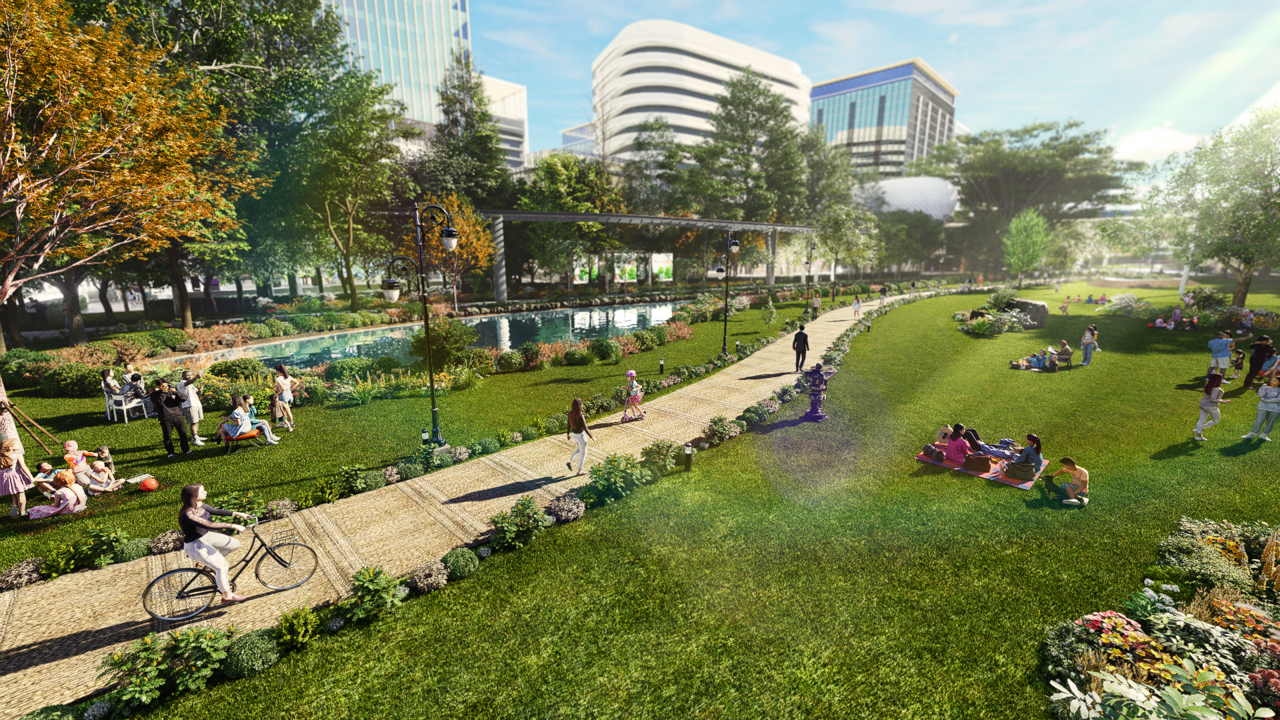
An artist’s render of a 15-minute city, where work, food, housing, education and cultural activities are easily within reach.

For the modern urban dweller, 15 minutes is a lot of time.

A lot of productive things can be done – a high-intensity, interval training (HITT) workout or run a 1.5-kilometer route, clearing your emails, meditating, catching up on the news, or preparing a quick smoothie – all within 15 minutes. 


But for the Metro Manila commuter, 15 minutes is barely enough to get from point A to point B. During rush hour, it is most likely that within this time, you still haven’t moved an inch.


Ever heard of the 15-minute city? It’s a modern urban planning concept that puts people and the planet first. The term was coined by Paris-based urbanist and Sorbonne University professor Carlos Moreno wherein he said that the ideal neighborhood or city is built in such a way where work, food, housing, education and cultural activities can be easily accessed within 15 minutes, whether by foot or by using a bike.

Pasay City, in its forward-looking 360-hectare smart city development, aims to create an innovative tropical 15-minute city for over 300,000 residents. 

Situated at the edge of a densely-packed and overpopulated metropolis perpetually in a traffic gridlock, this city will provide respite to its residents and visitors with sustainable, inclusive, safe, and healthy living where all their needs can be accessed within reach. 

Among its intended features, the project is envisioned to have low carbon and safe mobility networks with multimodal public transport services and enhanced infrastructure that prioritizes active mobility like walking and biking. There will be parking lots equipped with electric vehicle charging stations, dedicated bike lanes, easily accessible public transport hubs, and unimpeded pedestrian walkways.

An artist’s rendition of a soon-to-rise 15-minute city in Pasay

This assures lower transportation costs, less carbon emissions, and most importantly, healthier and happier people. No more long and tiring queues at the EDSA bus carousel or sitting hours on end in the middle of EDSA traffic. 

The project has been thoughtfully planned and designed for many years, and finally it has received the green light by government to proceed. In fact, no less than Albay 2nd district Rep. Joey Salceda highlighted how the Pasay-led project is expected to earn billions in real estate assets for the government. 

Revenues from the project will generate a massive multiplier effect on our gross domestic product (GDP) and an estimated 300,000 new jobs from 2027 to 2040. By 2035, it is projected to employ 4% of the National Capital Region’s (NCR) total work force.

The Pasay 360 Project will be a city that nurtures lives and livelihood, is expected to revitalize the economy, and hone the next generation of Filipino leaders. It can be a source of pride for Filipinos as we push towards the 22nd century.

Saturday, January 4, 2020

Sarmiento Offers Solution to EDSA Traffic


House Transportation Committee Chair and Samar 1st District Representative Edgar Mary Sarmiento unveiled Friday the blueprint of his proposed centralized and synchronized bus dispatch system which would turn the EDSA's rowdy and chaotic city buses into a fast, efficient and predictable mass transport system.
Sarmiento, a civil engineer, disclosed the full details of his proposal after announcing that his panel is closely working with the Department of Transportation (DoTr) to craft a roadmap which would solve EDSA's traffic problem.

In his proposal, Sarmiento said that the innermost lane of EDSA will serve as an "express bus lane" which can be accessed through stations used by the MRT. Like a carousel, the "express bus lane" will just circle around EDSA, duplicating the route of the MRT.

"People who use the MRT can now have the option to ride the bus which will be also operated like carousel. The buses will only load and unload passengers in a synchronized manner at the MRT stations so they are basically an extension of the MRT. Walang magiging traffic dyan because the entire inner lane from Taft Avenue to North Avenue and vice-versa will be enclosed and exclusive to the express bus lane ," Sarmiento said.

Sarmiento said that the three lanes in the middle of EDSA will be dedicated for all types of private vehicles subject to the existing vehicle reduction programs like the number coding scheme. Private cars will be only allowed to use the outer lane when turning into an intersection.

The outer lane of EDSA or the yellow lane will be used as a dedicated city bus lane which will also adopt a centralized and synchronized dispatch system. Dedicated bus stops will be established one kilometer apart. Loading and unloading of passengers will be strictly implemented on these bus stops.
Sarmiento said that while the express bus lane will cater to passengers who also use the MRT, the city bus lane operation will extend up to the ParaƱaque Integrated Bus Terminal (PITX) in the south and the Valenzuela Integrated Bus Terminal (VIBT) in the north and vice-versa.

" City buses will now be using the outermost lane in EDSA or the yellow lane. They will be traversing EDSA in a carousel-type system until they reach the proposed north terminal which is the Valenzuela Integrated Bus Terminal. From there, the city buses will now traverse to the south still using the outermost lane until it reaches the proposed south terminal which is the Paranaque Integrated Bus Terminal," Sarmiento said.

"We propose this to eradicate the kanya-kanya system of the buses wherein they compete with each other creating chaos through overtaking, overspeeding, and overstaying. Puno man o hindi, lalarga po ang mga city buses dahil may schedule na po ang biyahe nila at hindi na sila makikipag-agawan ng pasahero dahil hindi na commission-based ang kita kundi sahod na ang matatanggap ng mga drivers at konduktors," Sarmiento added.

Sarmiento said that also part of the proposal is to modernize the fare system using tap or beep card.

"Once everything has been set in theory and generated through computer by the MMDA, it will be presented to the public through a dry run, which will be implemented on a day with the least number of vehicles in the road. We are going to have a computer-generated simulation of this proposal to be led by the MMDA," Sarmiento said to dispel fears that this could end up just like the other failed "experiments" of the MMDA.

Sarmiento clarified however that his proposal can still be subject to improvements and adjustments by the DoTr and the MMDA which is will the frontline implementing agencies.

"Lastly, this proposal is a work in progress. Details will be discussed by the Executives. Ang inyong lingkod, bilang Chairman ng House Committee on Transportation ay willing na magbigay ng suporta sa DOTr kung may mga kailangang polisiya upang maipatupad natin kaagad ang mga planong ito," Sarmiento said.

Sarmiento said that if and when the plan is set into motion, the private vehicles that continue to clog EDSA middle lanes would be reduced eventually "because people would now start riding the bus rather than drive their car in what is described as one of the world's biggest parking lot."

"With this system, if the trains and buses will be fully operational, and the commuting public is now effectively and efficiently being moved, that’s the time that we can reduce the volume of private vehicles in EDSA and the major thoroughfares in Metro Manila," Sarmiento said.

" Once the volume of vehicles were reduced, that’s the time that we can introduce major infrastructures in EDSA and other major thoroughfares," he added.

Friday, February 12, 2016

10 Fast Facts about EDSA


MANILA, February 12, 2016: The Epifanio de los Santos Avenue, or EDSA, never fails to elicit a groan from drivers and commuters who have to traverse it every day. Due to its problematic traffic situation, it’s a pain to travel through, especially during rush hour.
But before it became the bane of Filipino motorists’ existence, the road was best known for being part of one of the most significant parts of our history. In 1986, EDSA literally and figuratively became the way to freedom when over two million civilians, politicians, and religious figures stormed the highway in a peaceful protest of the Marcos regime, and proved what a unified nation can do.
In honor of the upcoming 30th anniversary of the People Power Revolution, MyProperty.ph offers 10 quick facts about the historic main thoroughfare of Metro Manila.
  1. From end-to-end, EDSA is around 23.8 kilometers. That’s roughly the length of 1,561 professional basketball courts, or 14,691 Filipino males (who are said to be 162 centimeters tall on average) who play in them.
  2. EDSA passes through six cities of Metro Manila: 11 kilometers of the road is within Quezon City, and the rest is divided among Caloocan, San Juan, Mandaluyong, Makati, and Pasay.
  3. EDSA has gone through many name changes over the years. It started out as the “North-South Circumferential Road” during its construction back in the 1930s. After the country’s independence in 1946 from the Japanese occupation, EDSA was briefly named “Avenida 19 de Junio” or June 19 Avenue, the birth date of national hero JosĆ© Rizal. Another former name was “Highway 54,” due to the misconception that the avenue is 54 kilometers in length. It wasn’t until 1959 that Republic Act 2140 was passed declaring it the Epifanio de los Santos Avenue after the RizaleƱo historian, jurist, and scholar.
  4. In its conception, EDSA’s northernmost point was only supposed to be the Balintawak terminus and the southernmost end the South Luzon Expressway. But in 1965, the northern tip was extended to the Apolonio Samson Road, and the southern part to Roxas Boulevard until 2006, when it was further extended to the SM Mall of Asia.
  5. EDSA touches three of the country’s busiest financial and business hubs: the Makati Central Business District, Ortigas Center, and Araneta Center.
  6. There is currently a petition pending in the House of Representatives to rename EDSA “Corazon Aquino Avenue” in honor of the late president, who led the 1986 revolution.
  7. Since the People Power Revolution, EDSA has been the site of many other protests against succeeding administrations. EDSA II was a four-day rally in January 2001 that successfully ousted former president Joseph Estrada. In 2006, various groups picketed along EDSA to protest then-president Gloria Macapagal-Arroyo’s declaration of a State of Emergency. During the 29th anniversary of the first People Power Revolution, a demonstration was staged at EDSA Shrine against current president Benigno Aquino III and the supposed inadequacies of the government.
  8. In a 2013 piece by columnist Botchi Santos for the Philippine Daily Inquirer (PDI), he revealed that over 360,000 vehicles use EDSA every day. An unfortunate number, because according to PDI’s Rene S. Santiago, under ideal conditions, EDSA should have a capacity of only 200,000 vehicles a day.
  9. Speed limits are implemented along EDSA: 40 kph for cars and motorcycles, and 30 kph for trucks and buses. But due to the number of vehicles traversing the thoroughfare, traffic moves at an average speed of 15 kph.
  10. There are at least 10 condominiums built right along EDSA, including DMCI’s Zinnia Towers and New San Jose Builders, Inc.’s Victoria Sports Tower in Quezon City; Avida Towers Centera in Mandaluyong; Empire East’s San Lorenzo Place in Makati; and SMDC’s Shell Residences in Pasay.